
Durante siglos, la pregunta tuvo una respuesta cómoda: la creatividad era un misterio. Algo que les pasaba a unos pocos y que no se podía enseñar ni explicar. Hoy esa respuesta ya no alcanza. Un modelo genera cien imágenes en minutos. Si generar dejó de ser difícil, ¿qué es lo que llamamos crear?
Recorrí lo que dijeron filósofos, artistas y diseñadores. Quería ver qué queda en pie cuando producir se vuelve barato.
1. El rapto: crear como algo que te pasa
La idea más antigua es que la creatividad no es tuya. En el Ion, Platón hace decir a Sócrates que el poeta es "una cosa liviana, alada y sagrada", incapaz de crear hasta quedar fuera de sí. El mérito no es del poeta: es de la musa que habla a través de él.
Más de dos mil años después, Kant le dio a esa idea una forma moderna. En la Crítica del juicio (1790) define al genio como "el talento que da la regla al arte". El genio no sigue reglas: las produce. Y no puede explicar cómo lo hizo.
Las dos posturas comparten algo: dejan la creatividad afuera del método. Es inspiración o es don. En ninguno de los dos casos se puede diseñar.
2. Nada sale de la nada
El siglo XX desarmó ese misterio pieza por pieza. Henri Poincaré, matemático, describió en Ciencia y método (1908) cómo le llegaban los descubrimientos, y llegó a una conclusión inesperada: las combinaciones posibles son infinitas y casi todas inútiles, así que inventar consiste en elegir. "La invención es discernimiento, elección."
Arthur Koestler, en The Act of Creation (1964), llamó bisociación al momento en que se cruzan dos marcos de referencia que nunca se tocaban. El chiste, el descubrimiento científico y la metáfora poética nacen, según él, del mismo choque. Steve Jobs lo dijo más simple en una entrevista de 1996: "La creatividad es sólo conectar cosas."
La científica cognitiva Margaret Boden ordenó todo esto en The Creative Mind (1990) y distinguió tres formas de crear.
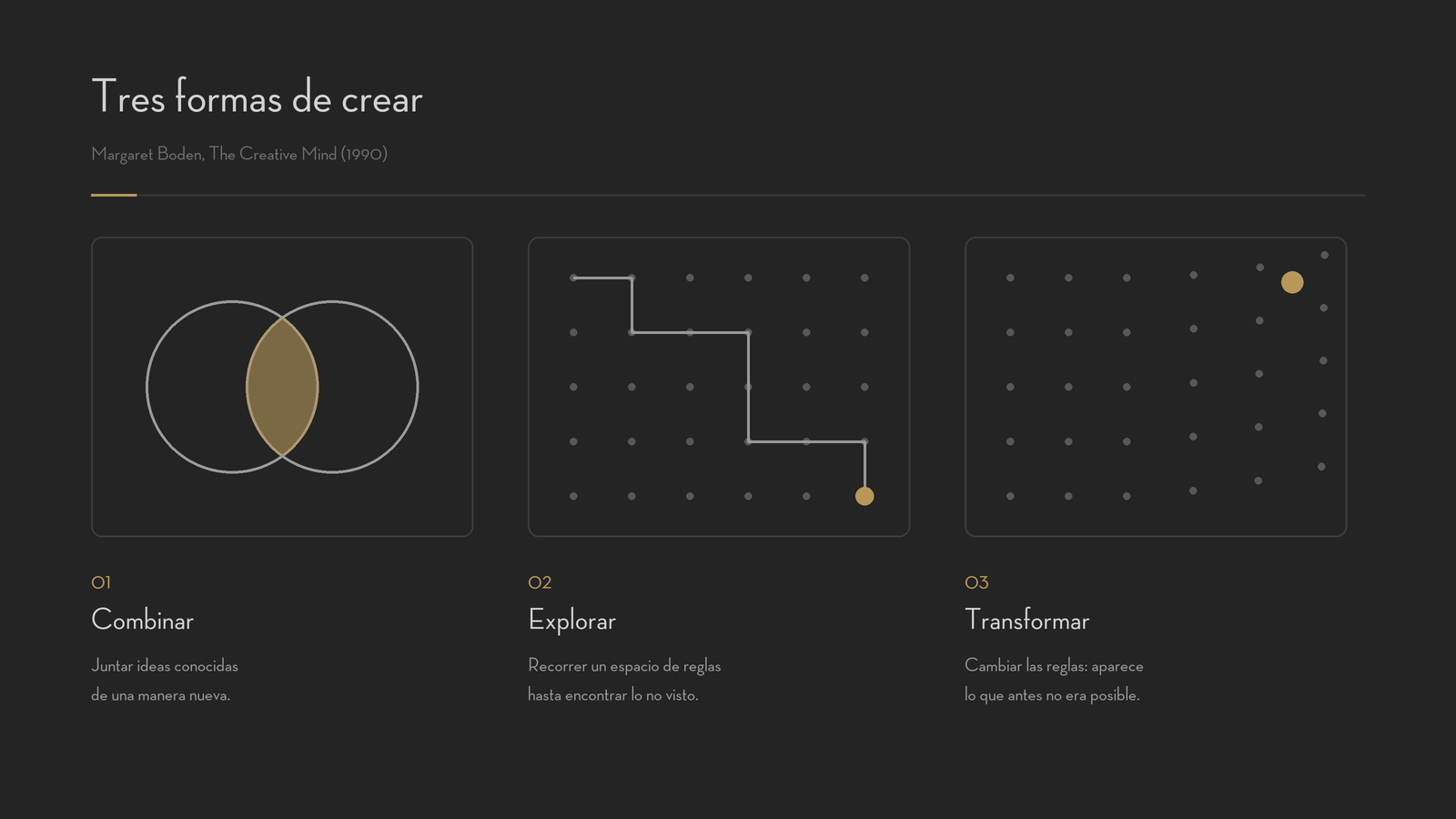
La primera es combinar: juntar ideas conocidas de una manera nueva. La segunda es explorar: recorrer un espacio de reglas hasta encontrar lo que nadie había visto adentro. La tercera, la más rara, es transformar: cambiar las reglas del espacio, de modo que aparece algo que antes ni siquiera era posible.
3. La restricción como motor
Si crear es elegir, el límite deja de ser un enemigo. Igor Stravinsky lo defendió en su Poética musical (1942): cuantas más restricciones se imponía, más se liberaba de las cadenas que traban al espíritu. Frente a un campo infinito se sentía perdido; con un límite claro, sabía por dónde empezar.
Charles y Ray Eames respondieron lo mismo desde el diseño. En las preguntas que les hizo el Museo de Artes Decorativas de París en 1969, publicadas después como Design Q&A, Charles dice: "El diseño depende en gran medida de las restricciones." Precio, tamaño, resistencia, tiempo: cada problema trae su propia lista, y reconocerla es una de las pocas llaves que existen.
Bruno Munari fue más lejos y convirtió la creatividad en método. En Da cosa nasce cosa (1981) propone una secuencia de pasos para proyectar y sostiene que la creatividad trabaja dentro del método. La fantasía propone y el método ordena.
4. El proceso como obra
En 1967, Sol LeWitt publicó en Artforum sus "Paragraphs on Conceptual Art". Una frase de ese texto podría estar escrita para cualquiera que arma un workflow: "La idea se vuelve una máquina que hace el arte." Para LeWitt, cuando todas las decisiones se toman antes, la ejecución es casi un trámite. Lo creativo está en diseñar el sistema.
Vera Molnár llegó al mismo lugar desde la pintura. Antes de tener acceso a una computadora trabajaba con lo que llamaba su machine imaginaire: una serie de procedimientos (desplazar, repetir, alterar) que aplicaba paso a paso, como si ella misma fuera una máquina. Cuando por fin tuvo una, le agregó algo que la máquina sola no tenía: un "1 % de desorden", una dosis de azar elegida a propósito para que el sistema no se volviera rígido.
5. Nadie crea solo
Hay otra línea de pensamiento que saca la creatividad del individuo. Marcel Duchamp, en una charla de 1957 llamada "El acto creativo", sostuvo que la obra la completa el espectador, que la descifra, la interpreta y así agrega su contribución al acto creativo.
Borges lo llevó al extremo en "Kafka y sus precursores": después de leer a Kafka, lo reconocemos en textos anteriores que no se parecían entre sí. Su conclusión: "cada escritor crea a sus precursores".
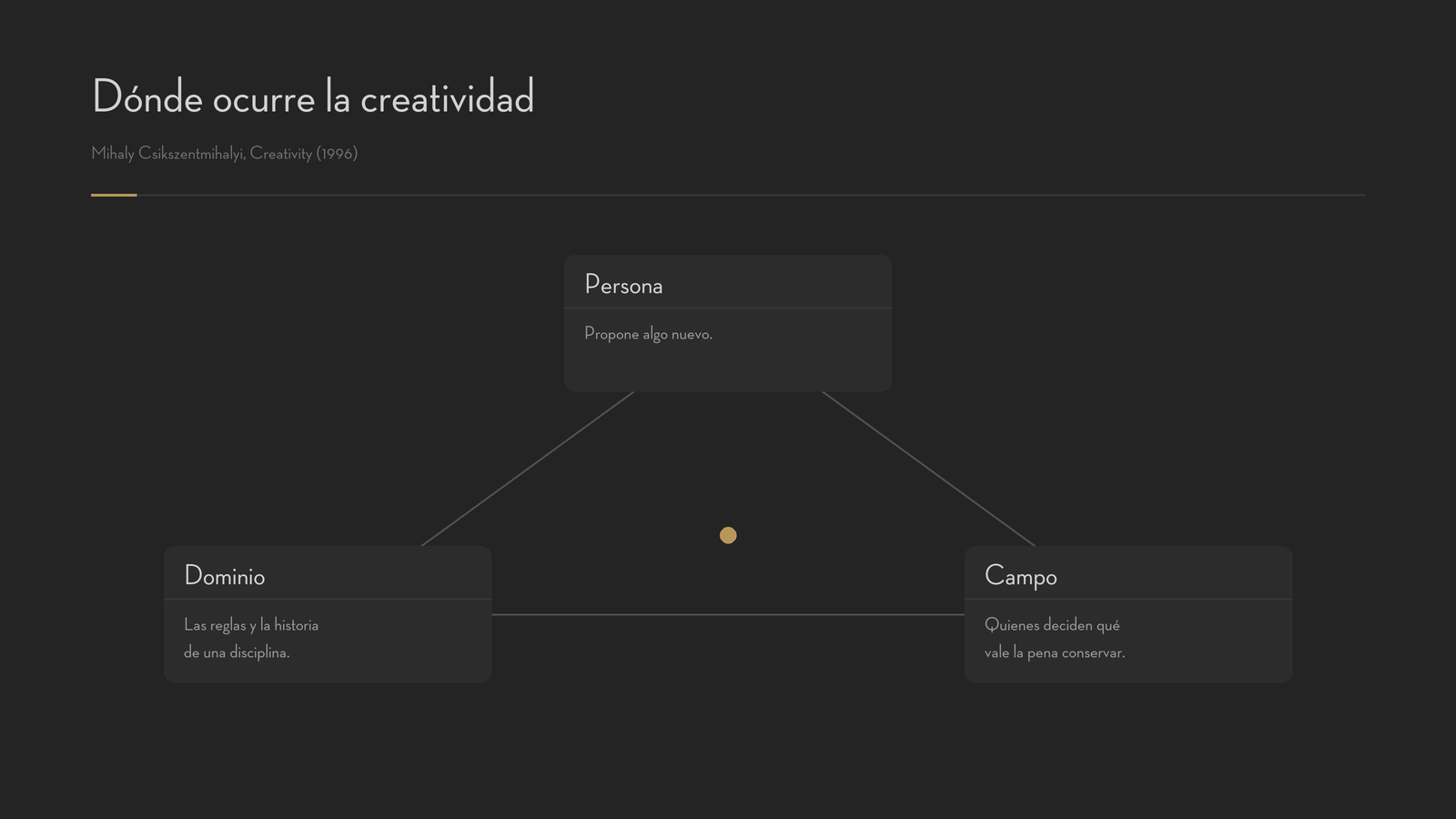
Mihaly Csikszentmihalyi lo formalizó en Creativity (1996). Para él, la creatividad ocurre en la relación entre tres partes: alguien que propone algo nuevo, un dominio con sus reglas y su historia, y un campo de personas que deciden qué vale la pena conservar.
Brian Eno inventó una palabra para eso: scenius, la inteligencia de toda una escena, frente al mito del genio solitario.
6. ¿Y la máquina?
La pregunta de si una máquina puede crear es más vieja que las computadoras. En 1843, Ada Lovelace escribió sobre la Máquina Analítica de Babbage que "no tiene ninguna pretensión de originar nada" y que "puede hacer todo lo que sepamos ordenarle que haga". Alan Turing le respondió en 1950, en un apartado que tituló "La objeción de Lady Lovelace": las máquinas, decía, lo sorprendían muy seguido.
En los años setenta, el pintor Harold Cohen escribió AARON, un programa que dibujaba solo, y pasó décadas preguntándose de quién eran esos dibujos. Boden, por su parte, propuso dejar de discutir si las máquinas "son" creativas y mirar qué tipo de creatividad producen. Hoy los modelos generativos combinan y exploran de manera asombrosa. Transformar, cambiar las reglas, sigue siendo otra cosa.
7. Lo que queda en pie
Si junto todas estas voces, la creatividad deja de parecer un rayo y empieza a parecer una serie de decisiones:
- Elegir entre infinitas combinaciones (Poincaré).
- Conectar marcos que no se tocaban (Koestler, Jobs).
- Poner límites que obliguen a encontrar algo (Stravinsky, los Eames).
- Diseñar el proceso, no sólo el resultado (Munari, LeWitt, Molnár).
- Dejar un margen de desorden para que aparezca lo inesperado (Molnár).
- Ofrecerlo a otros, que lo completan (Duchamp, Borges, Csikszentmihalyi).
Ninguna de estas decisiones desaparece cuando una máquina genera. Al contrario: cuanto más barato es producir, más pesa elegir. Lovelace tenía razón en algo: la máquina hace lo que sabemos pedirle. Lo que cambió es cuánto le podemos pedir. Y eso devuelve la pregunta al lugar de siempre: qué vale la pena imaginar.
Si tenés una definición propia, o una voz que falta acá, dejala en los comentarios.
Fuentes
- Platón, Ion.
- Immanuel Kant, Crítica del juicio (1790), §46.
- Henri Poincaré, "La invención matemática", en Ciencia y método (1908).
- Arthur Koestler, The Act of Creation (1964).
- Gary Wolf, "Steve Jobs: The Next Insanely Great Thing", Wired (1996).
- Margaret Boden, The Creative Mind: Myths and Mechanisms (1990).
- Igor Stravinsky, Poética musical (1942).
- Charles y Ray Eames, Design Q&A (1969; película de 1972).
- Bruno Munari, Da cosa nasce cosa (1981).
- Sol LeWitt, "Paragraphs on Conceptual Art", Artforum (1967).
- Vera Molnár, machine imaginaire y 1 % de désordre (1976).
- Marcel Duchamp, "The Creative Act" (1957).
- Jorge Luis Borges, "Kafka y sus precursores", en Otras inquisiciones (1952).
- Mihaly Csikszentmihalyi, Creativity: Flow and the Psychology of Discovery and Invention (1996).
- Ada Lovelace, Nota G a su traducción del artículo de Menabrea sobre la Máquina Analítica (1843).
- Alan Turing, "Computing Machinery and Intelligence", Mind (1950).
For centuries the question had a comfortable answer: creativity was a mystery. Something that happened to a few people and could be neither taught nor explained. That answer isn't enough anymore. A model generates a hundred images in minutes. If generating is no longer hard, what is it that we call creating?
I went through what philosophers, artists and designers have said. I wanted to see what's still standing once producing becomes cheap.
1. Rapture: creating as something that happens to you
The oldest idea is that creativity isn't yours. In the Ion, Plato has Socrates say that the poet is "a light and winged and holy thing", unable to create until he is out of his senses. The merit isn't the poet's: it belongs to the muse speaking through him.
More than two thousand years later, Kant gave the idea a modern shape. In the Critique of Judgment (1790) he defines genius as "the talent that gives the rule to art". Genius doesn't follow rules: it produces them. And it can't explain how it did it.
Both positions share something: they leave creativity outside of method. It's inspiration or it's a gift. Either way, it can't be designed.
2. Nothing comes from nothing
The twentieth century took the mystery apart piece by piece. Henri Poincaré, a mathematician, described in Science and Method (1908) how his discoveries came to him and reached an unexpected conclusion: possible combinations are endless and almost all of them useless, so inventing comes down to choosing. "Invention is discernment, choice."
Arthur Koestler, in The Act of Creation (1964), called bisociation the moment when two frames of reference that never touched suddenly cross. The joke, the scientific discovery and the poetic metaphor are all born, he argued, from the same collision. Steve Jobs put it more simply in a 1996 interview: "Creativity is just connecting things."
The cognitive scientist Margaret Boden organised all of this in The Creative Mind (1990) and told apart three ways of creating.
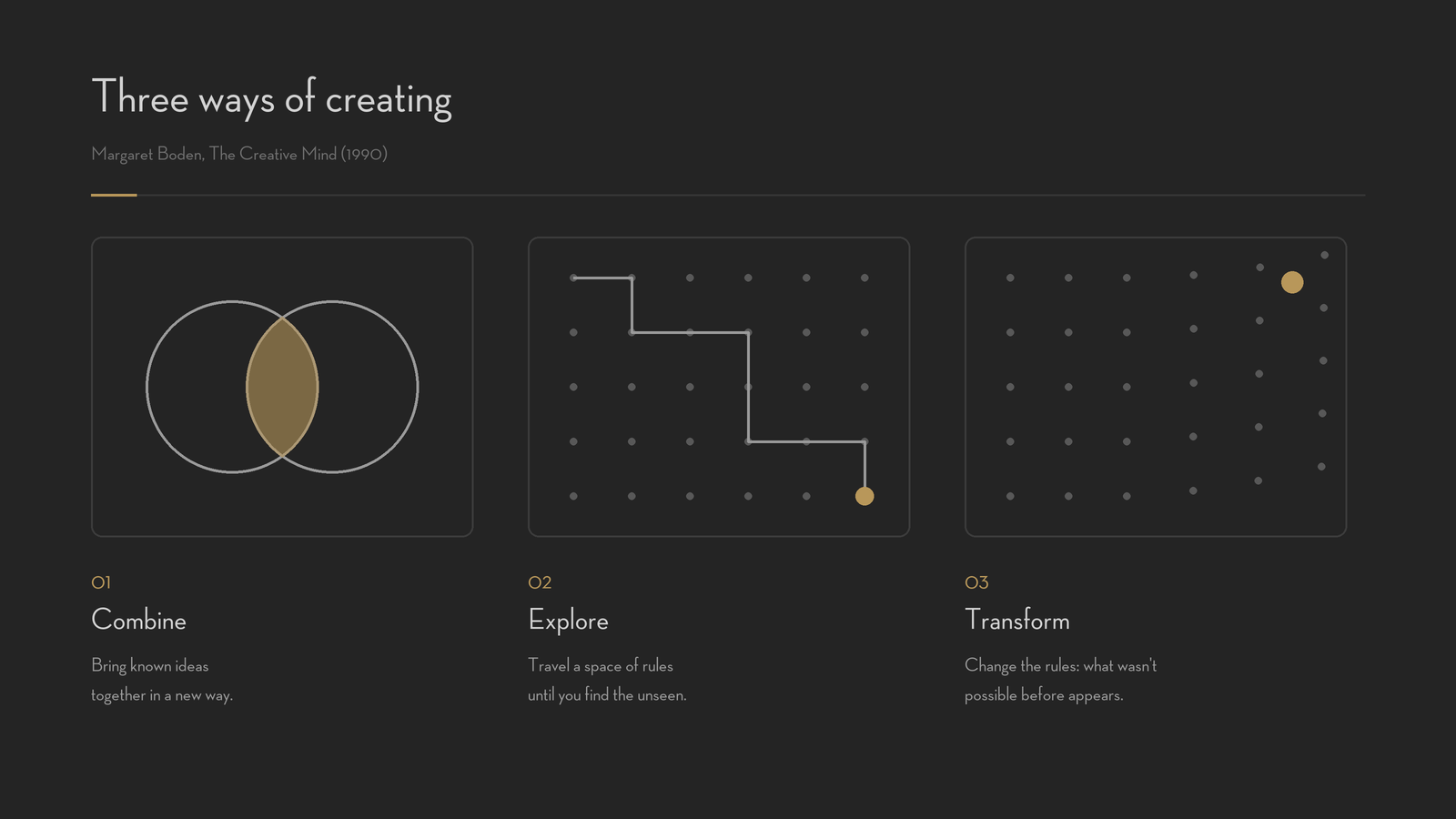
The first is combining: bringing known ideas together in a new way. The second is exploring: travelling a space of rules until you find what nobody had seen inside it. The third, and rarest, is transforming: changing the rules of the space, so that something appears that wasn't even possible before.
3. Constraint as an engine
If creating is choosing, limits stop being the enemy. Igor Stravinsky argued this in his Poetics of Music (1942): the more constraints he imposed on himself, the more he freed himself from the chains that shackle the spirit. Facing an infinite field he felt lost; with a clear limit, he knew where to begin.
Charles and Ray Eames gave the same answer from design. In the questions put to them by the Musée des Arts Décoratifs in Paris in 1969, later published as Design Q&A, Charles says: "Design depends largely on constraints." Price, size, strength, time: every problem brings its own list, and recognising it is one of the few keys there are.
Bruno Munari went further and turned creativity into a method. In Da cosa nasce cosa (1981) he proposes a sequence of steps for designing and holds that creativity works inside method. Fantasy proposes and method puts things in order.
4. The process as the work
In 1967 Sol LeWitt published his "Paragraphs on Conceptual Art" in Artforum. One sentence from that text could have been written for anyone who builds a workflow: "The idea becomes a machine that makes the art." For LeWitt, when every decision is made beforehand, the execution is almost a formality. The creative part is designing the system.
Vera Molnár got to the same place from painting. Before she had access to a computer she worked with what she called her machine imaginaire: a set of procedures (shifting, repeating, altering) applied step by step, as if she herself were a machine. When she finally got one, she added something the machine alone didn't have: "1% of disorder", a dose of chance chosen on purpose so the system wouldn't turn rigid.
5. Nobody creates alone
Another line of thought takes creativity away from the individual. Marcel Duchamp, in a 1957 talk called "The Creative Act", argued that the spectator completes the work: by deciphering and interpreting it, they add their contribution to the creative act.
Borges took it to the extreme in "Kafka and His Precursors": after reading Kafka, we recognise him in earlier texts that didn't resemble each other at all. His conclusion: "every writer creates his own precursors".
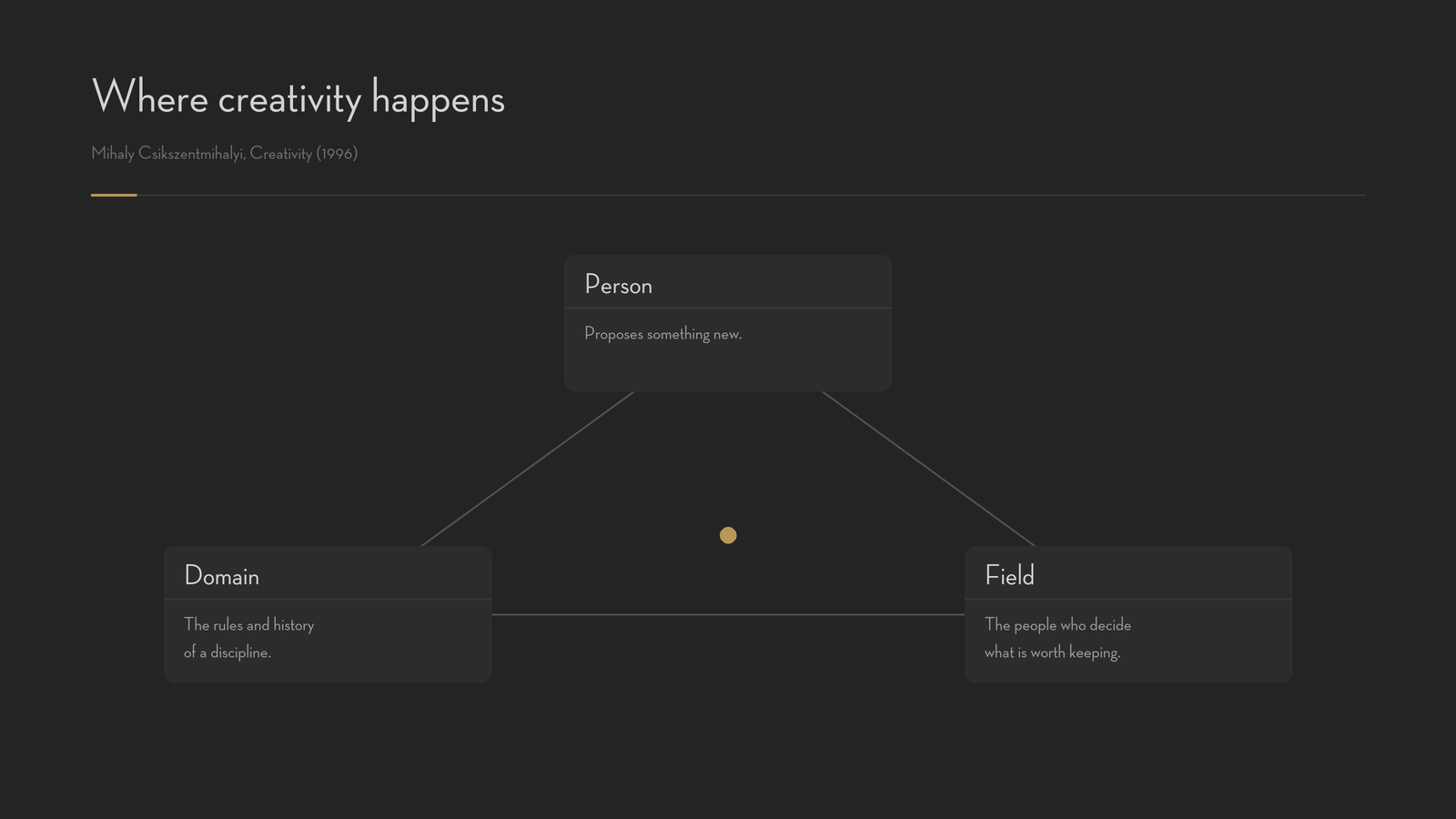
Mihaly Csikszentmihalyi formalised it in Creativity (1996). For him, creativity happens in the relationship between three parts: someone who proposes something new, a domain with its rules and history, and a field of people who decide what is worth keeping.
Brian Eno coined a word for it: scenius, the intelligence of a whole scene, as opposed to the myth of the lone genius.
6. And the machine?
Whether a machine can create is an older question than computers. In 1843 Ada Lovelace wrote that Babbage's Analytical Engine "has no pretensions whatever to originate anything" and that "it can do whatever we know how to order it to perform". Alan Turing answered her in 1950, in a section he titled "Lady Lovelace's Objection": machines, he said, took him by surprise with great frequency.
In the seventies the painter Harold Cohen wrote AARON, a program that drew on its own, and spent decades wondering whose drawings those were. Boden, for her part, proposed that we stop arguing whether machines "are" creative and look at which kind of creativity they produce. Today generative models combine and explore astonishingly well. Transforming, changing the rules, is still something else.
7. What's still standing
Put all these voices together and creativity stops looking like a lightning bolt and starts looking like a series of decisions:
- Choosing among endless combinations (Poincaré).
- Connecting frames that never touched (Koestler, Jobs).
- Setting limits that force you to find something (Stravinsky, the Eameses).
- Designing the process, not only the result (Munari, LeWitt, Molnár).
- Leaving a margin of disorder so the unexpected can show up (Molnár).
- Offering it to others, who complete it (Duchamp, Borges, Csikszentmihalyi).
None of these decisions disappears when a machine generates. On the contrary: the cheaper it is to produce, the more choosing matters. Lovelace was right about one thing: the machine does what we know how to ask of it. What changed is how much we can ask. And that brings the question back to where it always was: what is worth imagining.
If you have a definition of your own, or a voice that's missing here, leave it in the comments.
Sources
- Plato, Ion.
- Immanuel Kant, Critique of Judgment (1790), §46.
- Henri Poincaré, "Mathematical Creation", in Science and Method (1908).
- Arthur Koestler, The Act of Creation (1964).
- Gary Wolf, "Steve Jobs: The Next Insanely Great Thing", Wired (1996).
- Margaret Boden, The Creative Mind: Myths and Mechanisms (1990).
- Igor Stravinsky, Poetics of Music (1942).
- Charles and Ray Eames, Design Q&A (1969; film, 1972).
- Bruno Munari, Da cosa nasce cosa (1981).
- Sol LeWitt, "Paragraphs on Conceptual Art", Artforum (1967).
- Vera Molnár, machine imaginaire and 1% de désordre (1976).
- Marcel Duchamp, "The Creative Act" (1957).
- Jorge Luis Borges, "Kafka and His Precursors", in Other Inquisitions (1952).
- Mihaly Csikszentmihalyi, Creativity: Flow and the Psychology of Discovery and Invention (1996).
- Ada Lovelace, Note G to her translation of Menabrea's paper on the Analytical Engine (1843).
- Alan Turing, "Computing Machinery and Intelligence", Mind (1950).